
Introduction
The Academic Performance Index (API) is an important system used in the education sector to measure and evaluate the academic achievements of students and the overall performance of schools or educational institutions. Educational systems around the world rely on different assessment tools to determine how well students are learning and how effectively schools are delivering education. The Academic Performance Index provides a structured method to analyze academic results and track improvements over time.
The concept of academic performance measurement has gained significant attention over the past few decades. Governments, educational authorities, teachers, and parents all want to understand whether students are achieving the expected learning outcomes. The Academic Performance Index helps provide a clear picture of student progress by converting academic results into measurable data.
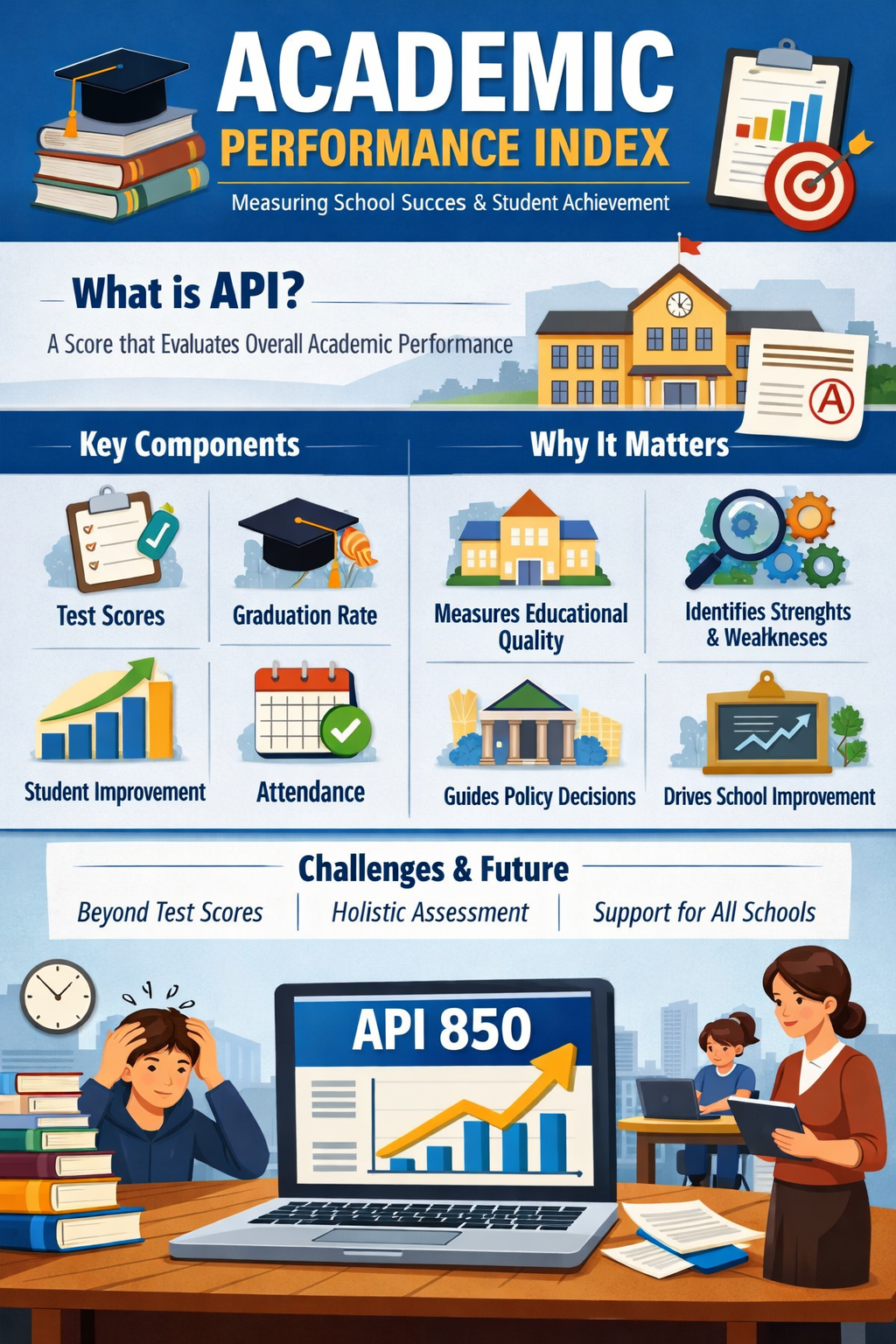
In simple terms, the Academic Performance Index is a numerical score or rating system that reflects the academic success of students or institutions. It often combines multiple indicators such as test scores, subject performance, graduation rates, and sometimes attendance or improvement over time. By analyzing these indicators, educators can identify strengths, weaknesses, and areas that require improvement.
This article explains the concept of the Academic Performance Index, its components, importance, calculation methods, benefits, limitations, and its role in improving the quality of education.
Understanding the Academic Performance Index
The Academic Performance Index is designed to provide a comprehensive evaluation of academic achievement. Instead of focusing on a single exam or test, it takes into account multiple factors that contribute to educational success.
Educational institutions often use API scores to determine how well students are performing compared to academic standards. The system converts academic results into a single index number that represents overall performance.
For example, if a school receives an API score of 800 out of 1000, it indicates a relatively high level of academic achievement among students. Lower scores may signal the need for educational improvements or policy changes.
The purpose of the Academic Performance Index is not only to measure performance but also to encourage continuous improvement in teaching and learning.
History and Development of the Academic Performance Index
The idea of evaluating educational performance through numerical indices began when governments started focusing more on accountability in education. Educational reforms in many countries aimed to ensure that schools provide quality education and that students achieve academic standards.
Over time, educational authorities developed systems to measure school performance objectively. The Academic Performance Index became a widely used model in several regions because it allowed policymakers to compare schools, track student progress, and implement educational reforms.
As technology and data analysis improved, the API system also evolved. Modern versions of academic performance measurement now include digital data collection, advanced analytics, and more detailed evaluation criteria.
Components of the Academic Performance Index
The Academic Performance Index is usually calculated based on several key components. These components vary depending on the educational system but generally include the following:
1. Student Test Scores
Standardized test scores are one of the most important elements used in calculating the Academic Performance Index. These tests measure students’ understanding of subjects such as mathematics, science, and language.
Higher test scores contribute to a higher API score, indicating strong academic performance.
2. Subject Performance
Different subjects may carry different weights in the index. For example, core subjects like mathematics and language are often given greater importance in the calculation.
This ensures that the index reflects performance in essential academic areas.
3. Graduation Rates
In some educational systems, graduation rates are included in the Academic Performance Index. Schools with higher graduation rates generally receive better API scores because it indicates successful completion of academic programs.
4. Student Improvement
Some versions of the API measure improvement over time rather than just final results. If students show significant progress from one year to another, it can positively impact the index score.
5. Attendance and Participation
Regular attendance and student engagement may also be included as performance indicators. High attendance rates usually correlate with better academic outcomes.
How the Academic Performance Index Is Calculated
The calculation of the Academic Performance Index typically involves converting different academic indicators into a numerical scale. Each performance level is assigned a specific number of points.
For example:
- Advanced performance may receive the highest points.
- Proficient performance receives slightly lower points.
- Basic performance receives moderate points.
- Below basic performance receives fewer points.
These points are then averaged or weighted according to the importance of each subject or indicator.
After combining all the scores, the final result is presented as the Academic Performance Index score. This score allows easy comparison between different schools, classes, or academic years.
Importance of the Academic Performance Index
The Academic Performance Index plays a significant role in improving education systems. It offers several advantages for students, teachers, administrators, and policymakers.
1. Measuring Educational Quality
One of the main purposes of the Academic Performance Index is to measure the quality of education provided by institutions. By analyzing API scores, authorities can determine whether schools are meeting educational standards.
2. Identifying Strengths and Weaknesses
The index helps identify areas where students perform well and areas where improvement is needed. For example, if students consistently score lower in mathematics, schools can focus on improving teaching methods in that subject.
3. Encouraging Accountability
Educational institutions are held accountable for their academic performance through the API system. Schools are encouraged to maintain high standards and continuously improve their teaching strategies.
4. Supporting Educational Policy Decisions
Government agencies often use API data to make informed decisions about educational policies, funding, and reforms. Schools with lower scores may receive additional support or resources.
5. Motivating Students and Teachers
Performance indices can motivate both students and teachers to achieve better results. When progress is measurable, it encourages individuals to work harder and improve their performance.
Benefits of Using the Academic Performance Index
The Academic Performance Index provides several practical benefits in the educational environment.
Clear Performance Measurement
The API converts complex academic data into a simple numerical score, making it easier to understand and analyze performance.
Data-Driven Decision Making
Educational leaders can make better decisions when they have accurate data about student performance and school effectiveness.
Performance Comparison
The index allows comparison between different schools, districts, or academic years. This helps identify best practices and successful teaching strategies.
Continuous Improvement
Because the index is measured regularly, it encourages schools to continuously improve their academic programs and teaching methods.
Challenges and Limitations of the Academic Performance Index
Although the Academic Performance Index is a useful tool, it also has some limitations.
Overemphasis on Test Scores
One common criticism is that the API relies heavily on standardized test results. This may overlook other important aspects of education such as creativity, critical thinking, and extracurricular activities.
Pressure on Students and Teachers
High-stakes performance measurement can create stress for both students and teachers. Some schools may focus excessively on exam preparation rather than holistic learning.
Limited Representation of Learning
Academic performance indices may not fully capture the complete educational experience of students. Learning involves many factors beyond test results.
Risk of Inequality
Schools in disadvantaged areas may struggle to achieve high API scores due to socioeconomic challenges, which may unfairly affect their evaluation.
Improving the Academic Performance Index System
Educational experts suggest several improvements to make the Academic Performance Index more effective.
Balanced Assessment
Including multiple forms of evaluation such as projects, presentations, and classroom participation can provide a more comprehensive view of student performance.
Holistic Education Measurement
Modern educational systems should measure not only academic knowledge but also skills such as creativity, collaboration, and problem-solving.
Support for Low-Performing Schools
Instead of simply ranking schools, the API system should also provide resources and guidance to help underperforming institutions improve.
Use of Technology
Digital learning platforms and data analytics can enhance the accuracy and efficiency of academic performance measurement.
The Role of Teachers in Academic Performance Improvement
Teachers play a critical role in improving the Academic Performance Index of their students. Effective teaching strategies can significantly influence learning outcomes.
Teachers who provide engaging lessons, encourage critical thinking, and offer personalized support can help students achieve better academic results. Professional development programs for teachers also contribute to improving educational quality.
The Role of Parents and Students
Parents and students also influence academic performance. Parental support, a positive learning environment at home, and student motivation are essential factors in achieving high academic performance.
Students who develop good study habits, manage their time effectively, and actively participate in learning activities are more likely to perform well academically.
Future of Academic Performance Measurement
The future of academic performance evaluation is likely to involve more advanced technology and innovative assessment methods.
Artificial intelligence, digital learning platforms, and educational data analytics are already transforming the way academic performance is measured. These technologies allow educators to track student progress in real time and provide personalized learning experiences.
In the future, academic performance indices may include a wider range of indicators such as digital skills, creativity, and emotional intelligence.
Conclusion
The Academic Performance Index is a valuable tool used to measure and evaluate educational outcomes. By converting academic achievements into measurable data, the index helps educators, policymakers, and institutions understand how effectively students are learning.
Although the system has some limitations, it remains an important method for tracking progress, identifying challenges, and improving the quality of education. When used responsibly and combined with holistic assessment methods, the Academic Performance Index can contribute significantly to educational development.
Ultimately, the goal of any academic performance measurement system should be to support student success, enhance teaching quality, and create a more effective and inclusive education system. As education continues to evolve, the Academic Performance Index will likely adapt and improve, helping schools and students achieve higher standards of learning and academic excellence.
