
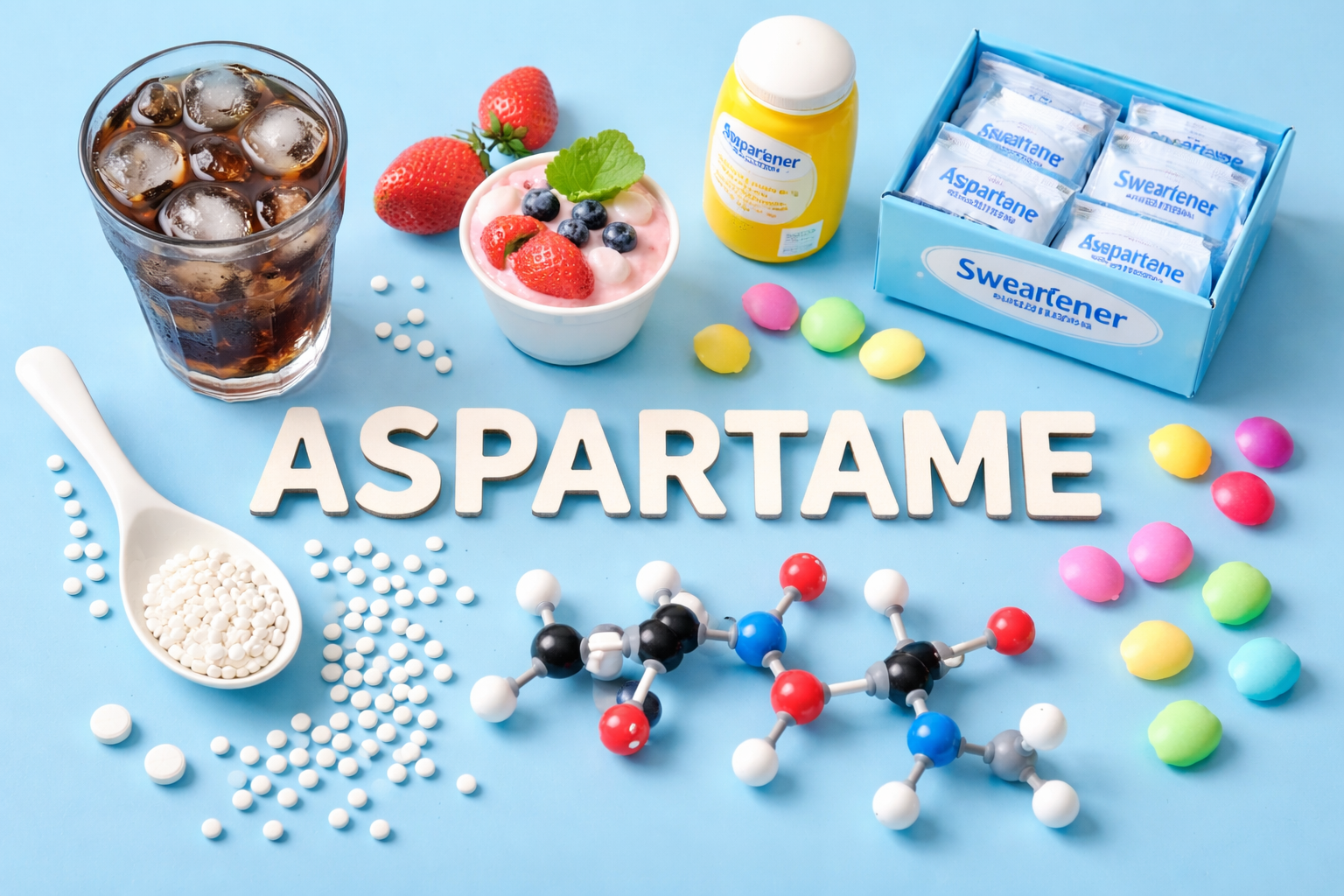
Aspartame is one of the most widely used artificial sweeteners in the world. Appearing in products from soft drinks to chewing gum to tabletop sweetener packets, it has touched the daily lives of millions. Yet, despite — or perhaps because of — its popularity, aspartame is also one of the most controversial food additives ever created. Its safety, metabolism, health effects, environmental impact, regulatory history, and cultural perception have been topics of intense scientific study and public debate for decades.
This article offers an in‑depth, balanced look at aspartame — what it is, how it works, what science says about its safety, and why it remains controversial.
1. What Is Aspartame?
Aspartame is a low‑calorie artificial sweetener discovered in 1965 by chemist James M. Schlatter. It is approximately 200 times sweeter than sucrose (table sugar), meaning only tiny amounts are needed to achieve sweetness comparable to sugar.
1.1 Chemical Structure
Chemically, aspartame is a dipeptide methyl ester, made from two amino acids:
- Aspartic acid
- Phenylalanine
When consumed, aspartame breaks down into these amino acids plus a small amount of methanol — a normal byproduct of many foods.
Although its components are naturally occurring substances, aspartame’s artificial form and intense sweetness set it apart from natural sugars.
2. How Does Aspartame Taste and Why Is It Used?
Aspartame’s appeal lies in its ability to mimic the sweetness of sugar without the calories. Because it is sweeter than sugar, much less is needed to provide the same taste — which makes it ideal for calorie‑reduced foods and beverages.
2.1 Uses in Food and Drinks
Aspartame is widely found in:
- Low‑calorie soft drinks
- Sugar‑free chewing gum
- Yogurts and dairy products
- Diet candies
- Sugar‑free desserts
- Tabletop sweetener packets (e.g., Equal, NutraSweet)
Its extensive use stems from the public demand for reduced‑calorie foods and beverages.
3. How Does the Body Metabolize Aspartame?
After ingestion, aspartame is broken down in the digestive tract into:
- Aspartic acid
- Phenylalanine
- Methanol
These components are absorbed and processed by normal metabolic pathways:
3.1 Aspartic Acid
An amino acid that the body uses to make proteins and neurotransmitters. Free aspartic acid from aspartame contributes minimally compared to amounts found in protein‑rich foods.
3.2 Phenylalanine
Also a natural amino acid found in many foods. In most people, phenylalanine from aspartame joins the body’s normal amino acid pool. However, people with the genetic condition phenylketonuria (PKU) must strictly limit phenylalanine intake, leading to mandatory product labeling.
3.3 Methanol
Methanol from aspartame is produced in tiny amounts and rapidly converted into formaldehyde and formic acid, then eliminated. The amounts are far lower than those from many fruit juices and fermented beverages.
4. Regulatory Review and Safety Evaluations
Aspartame has been intensely studied for safety. Multiple regulatory agencies around the world have reviewed decades of evidence.
4.1 U.S. Food and Drug Administration (FDA)
The FDA approved aspartame for specific uses in 1981 and expanded it for general use in 1996. It set an Acceptable Daily Intake (ADI) of 50 mg per kg of body weight per day.
To exceed the FDA ADI, a 70‑kg adult (154 lbs) would have to consume more than:
3,500 mg of aspartame daily — equivalent to about 19 cans of diet soda
This level is far above typical consumption.
4.2 World Health Organization (WHO)
WHO and Joint FAO/WHO Expert Committee on Food Additives (JECFA) set an ADI of 40 mg/kg/day, slightly more conservative but still significantly higher than average exposure.
4.3 European Food Safety Authority (EFSA)
EFSA conducted a major safety re‑evaluation in 2013 and reaffirmed aspartame’s safety at current dietary levels.
5. Health Controversies and Concerns
Despite regulatory approval, aspartame has faced decades of debate and conflicting claims about safety.
5.1 Cancer Risk
Concern: Some claim aspartame causes cancer.
What science says: Large prospective studies, including from the National Cancer Institute (NCI), found no convincing links between aspartame consumption and cancer in humans at typical exposures.
Animal studies that suggested potential cancer risk involved extremely high doses far above normal human consumption.
5.2 Headaches and Neurological Effects
Some individuals report headaches or mood changes after consuming aspartame.
Research: Controlled clinical trials show mixed results. While a minority of people may be sensitive, the evidence does not support widespread neurological harm at normal consumption levels.
5.3 Weight and Appetite
There’s a debate over whether artificial sweeteners help or hinder weight control.
Some studies suggest that replacing sugar with aspartame can reduce calories and support weight loss. Others raise questions about possible subtle effects on appetite or metabolic signaling.
Overall, evidence supports that replacing sugar with a non‑caloric sweetener reduces calorie intake and helps weight management when part of a broader healthy eating plan.
5.4 Mood and Behavior
Occasionally, claims appear linking aspartame to mood disorders or behavioral changes. Most systematic reviews do not find strong evidence supporting this, though individual sensitivity cannot be ruled out.
6. Phenylketonuria (PKU) — A Special Case
People with PKU, a rare inherited metabolic disorder, cannot metabolize phenylalanine properly. Thus, aspartame — which contains phenylalanine — must be avoided.
Products containing aspartame are labeled:
“Phenylketonurics: Contains Phenylalanine.”
This labeling requirement protects people with PKU from accidental intake.
7. Aspartame vs. Other Sweeteners
Artificial and natural non‑nutritive sweeteners come in many forms. How does aspartame compare?
| Sweetener | Relative Sweetness (vs. Sugar) | Calories | Notes |
|---|---|---|---|
| Aspartame | ~200× | ~0 | Tastes similar to sugar but unstable with heat |
| Sucralose | ~600× | 0 | Heat‑stable; used for baking |
| Saccharin | ~300× | 0 | Older sweetener, bitter aftertaste |
| Stevia (Rebaudioside A) | ~200–350× | 0 | Natural plant extract |
| Acesulfame‑K | ~200× | 0 | Often blended with other sweeteners |
Each sweetener has its benefits and use‑case depending on taste, heat stability, and desired product.
8. Heat Stability and Cooking
Aspartame breaks down under high heat, so it is not ideal for baking or cooking at high temperatures. The aspartame molecule degrades, losing sweetness and sometimes creating a bitter taste.
For cook‑friendly alternatives, manufacturers often use sucralose or stevia blends.
9. Sweetness Perception and Taste Profile
Aspartame’s taste is considered more sugar‑like than many older artificial sweeteners, with less of a bitter or metallic aftertaste. However, some people still detect lingering sweetness or flavor differences.
Manufacturers often blend aspartame with other sweeteners (like acesulfame‑K) to improve overall taste and mask aftertastes.
10. Environmental and Production Considerations
Aspartame production involves chemical synthesis of amino acids and fermentation steps. Compared with sugar production (which uses under intensive agriculture), aspartame has a relatively small environmental footprint per unit of sweetness due to the tiny amounts used.
However, like all industrial food ingredients, it contributes to broader environmental discussions about food systems, production waste, and synthetic additives.
11. Consumer Perceptions and Public Debate
Aspartame’s story is not purely scientific — it is cultural.
11.1 Early Media Coverage
In the 1980s and 1990s, media reports sensationalized safety concerns, sparking public fear and mistrust.
Some activists cited controversial animal studies — which have since been reassessed — as evidence of danger.
11.2 Internet and Social Media
Today, misinformation about artificial sweeteners circulates widely. Claims of addiction, chemical toxicity, brain damage, and cancer are common online — despite strong evidence against such effects at typical intakes.
12. Aspartame in Popular Culture
Diet soda drinkers, athletes, weight‑loss followers, diabetics, and those cutting calories all encounter aspartame in popular culture. It’s frequently referenced in discussions about:
- Weight loss and dieting
- Sugar reduction
- Diabetes management
- Clean eating and “chemical” food avoidance
- Debates about processed foods
Both praise and criticism of aspartame often reflect broader dietary philosophies rather than purely scientific evidence.
13. Pros and Cons of Aspartame
Pros
- Very low in calories — helps reduce total energy intake
- Much sweeter than sugar — small quantities work
- Approved by major safety authorities
- Doesn’t raise blood glucose — helpful for people with diabetes
- Widely available and well‑studied
Cons
- Not heat‑stable — not ideal for all cooking
- Phenylalanine content — risk for PKU
- Taste sensitivity — some find it bitter or artificial
- Public skepticism and controversy — despite safety data
14. Is Aspartame Safe? What Does the Science Say?
The consensus of expert panels globally is clear: Aspartame is safe for the general population at current consumption levels.
- FDA, EFSA, WHO/JECFA all uphold its safety.
- Long‑term epidemiological studies show no strong link to cancer.
- Most adverse effects claims have not been consistently reproducible.
While no food additive is absolutely risk‑free under all circumstances, the evidence supports safe use for most people.
15. Practical Guidance for Consumers
If you’re wondering how aspartame fits into your diet, here’s practical advice:
15.1 Moderation Is Key
Although aspartame is safe at typical consumption levels, moderation is generally wise with all artificial additives.
15.2 Check Labels
Read ingredient lists if you want to avoid or monitor intake. Phenylalanine labeling helps people with PKU.
15.3 Personalized Responses Vary
Some individuals may notice mild symptoms after artificial sweetener consumption — pay attention to your own body.
16. Future Research and Innovation
Aspartame research continues in areas such as:
- Long‑term metabolic effects
- Gut microbiome interactions
- Sweetness perception and neurobiology
- New formulations with improved taste and stability
- Alternative low‑calorie sweeteners
Scientific understanding evolves with more sophisticated tools, but decades of data support current safety conclusions.
17. Summary
Aspartame is a powerful artificial sweetener used worldwide to reduce sugar and calorie intake. Its discovery revolutionized diet foods and beverages. Despite persistent controversy and public distrust in some sectors, regulatory reviews across major health agencies support its safety at normal intake levels.
Aspartame — like many food additives — sits at the intersection of nutrition science, industry interests, public health, and cultural perception. Understanding it requires separating sensational claims from evidence‑based conclusions.
For most people, aspartame can be part of a balanced dietary approach — especially when used thoughtfully within broader goals of healthy eating.
